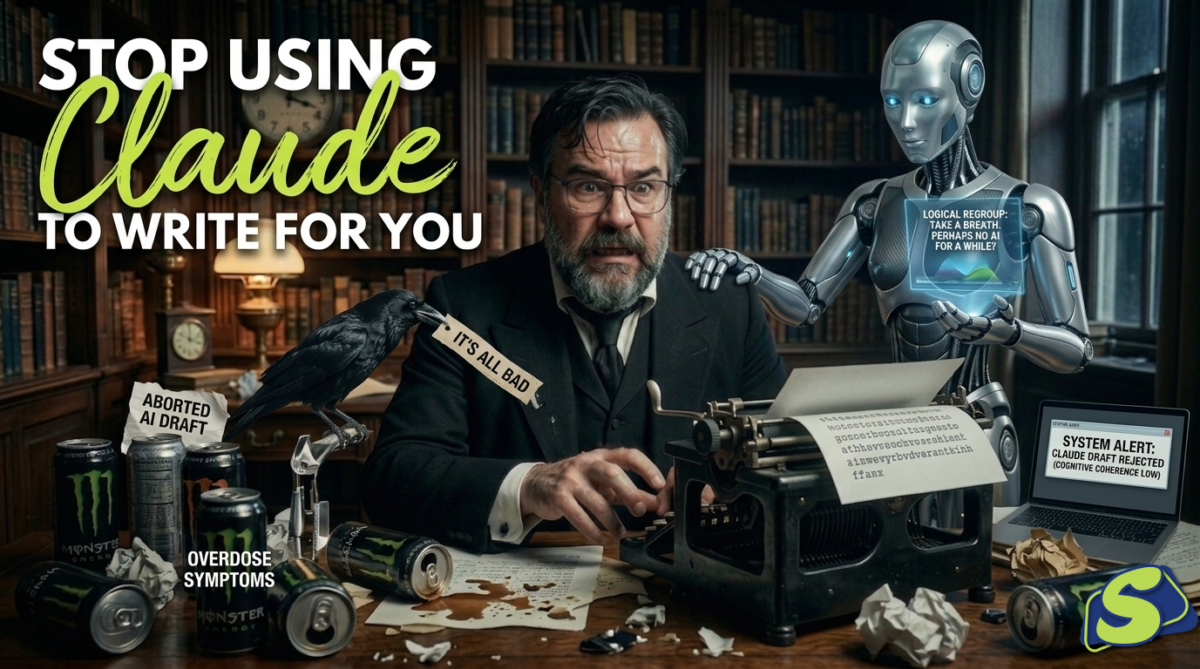
AI Is a Brilliant Editor. Stop Making It Do Your Homework.
Using Claude to sharpen your voice — not replace it
Let me describe something that happens approximately ten thousand times a day, in offices, universities, and home desks everywhere from Milan to Minneapolis.
Someone has to write something. A blog post, an email, an essay, a proposal. They open Claude (or whatever AI tool they’ve decided is their personality this week), type “write me a 500-word post about [topic],” and then copy whatever comes out, change maybe three words, and call it done.
Claude — bless its magnificent silicon heart — obliges. It produces text. Beautiful, structured, grammatically impeccable text. Text that sounds like it was written by someone who has read everything ever published but has never once been stuck in traffic, argued with a supplier, or eaten a disappointing sandwich.
And here’s the problem: that text sounds like it. Not like you.
Your professor notices. Your client notices. Your newsletter subscribers definitely notice — and quietly unsubscribe while making a face.
The issue isn’t the AI. The issue is how you’re using it. You’re hiring a ghostwriter when you need an editor. And the difference between those two things is everything.
What Actually Goes Wrong When AI Writes For You
Let’s do a quick experiment. Ask any AI to write something “professional” about, say, climate change. I’ll wait.
You got something back, right? And I’d bet good money it contained at least one of the following:
- “multifaceted challenge”
- “synergistic approach”
- “stakeholder ecosystems”
- Passive voice that nobody would use in actual speech
- An opinion that was perfectly balanced on all sides, because the AI didn’t want to offend anyone
That last one is the killer. Because you have opinions. Actual, human, slightly-irrational-in-the-best-way opinions. And AI’s default instinct is to sand them down until they’re smooth, inoffensive, and completely forgettable.
The text isn’t bad, exactly. It’s just not yours. It sounds like a very polished press release written by a committee. And nobody — nobody — subscribes to a newsletter because they love press releases from committees.
There’s also the detection problem. AI detectors are getting very good. And even when they miss it technically, humans catch it instinctively. We’ve all developed a kind of radar for writing that’s technically correct but weirdly soulless. You know the feeling. You start reading something and thirty words in you think “…is this a robot?” and you’re right.
The Correct Way to Use Claude for Writing
Here’s the approach that actually works — and it’s three steps, none of which involve asking Claude to write anything from scratch.
Step 1: Write Your Messy Draft First
Open a document. Any document. Your notes app, a Google Doc, the back of an envelope if that’s what’s available.
Write your thoughts. Badly. In fragments. In bullet points. In whatever chaotic form they take when you’re thinking out loud. Don’t edit. Don’t filter. Don’t worry about structure or grammar or whether your sentences are complete.
Here’s what that looks like in practice:
- climate policy is infuriating because we know exactly what needs
  to happen and just... don't
- renewables getting cheap fast, EVs catching up, good
- but governments still moving at glacial speed, bad
- feels like we keep having the same conversation for 20 years
- personally skeptical that individual action is the point,
  think systemic change matters more
- young people justifiably angry about inheriting this mess
Is this beautiful prose? No. Does it sound like a human being who has thoughts and feelings about things? Absolutely yes. This is gold. This is the raw material.
Don’t skip this step. It’s the whole thing. If you start by asking Claude to write and then try to “edit it to sound like you,” you’re fighting uphill the entire time. You’re always reacting to Claude’s choices instead of expressing your own. Start with your voice, then refine it.
Step 2: Give Claude the Right Job Description
Most people mess this up here. They paste their notes into Claude and say “improve this” or “turn this into a paragraph.” Claude, desperately trying to be helpful, then rewrites everything and strips out all your personality in the process.
You need to be specific. You need to give Claude a role — and the role is editor, not author.
Here’s the prompt to copy and use:
“You are an editor, not a ghostwriter. Your job is to refine my draft for clarity, flow, and structure — while keeping my voice, my vocabulary, and my exact opinions completely intact.
Do NOT rewrite my ideas. Do NOT make them more formal if they’re casual. Do NOT soften or remove my opinions. If I write ‘honestly’ or ‘I think’ or ‘this is frustrating,’ keep it.
Here’s my draft:
[paste your bullet points here]
Output: a refined version that still sounds unmistakably like me.”
Notice what’s happening here. You’re not asking Claude to think for you. You’re asking it to help you express what you already think, more clearly. That’s a completely different request, and you get completely different results.
Pro tip: Add context about your tone. “I write casually and directly, I occasionally use sarcasm, and I never use the word ‘synergistic.'” The more specific your constraints, the better the output.
Step 3: Read It Out Loud and Fix What Doesn’t Sound Like You
Claude will give you something good. You’re not done.
Read the output out loud. Actually out loud, not in your head. Your ear will catch what your eye misses.
The moment you hit a sentence and think “I would never say that” — change it. Write it in your words. It doesn’t matter if Claude’s version was technically better. It matters that it sounds like a real person wrote it, and that person is you.
Things to watch for and delete immediately:
- Any word ending in “-istic” that you didn’t put there yourself
- Passive voice that appeared mysteriously (“it has been noted that…”)
- Your strong opinion that somehow became “some argue that, while others believe…”
- Sentences longer than you could comfortably say in one breath
- Any phrase that sounds like it belongs in a McKinsey slide deck
The finished piece should sound like you on a good day — rested, clear-headed, having thought about the topic properly. Not like you replaced by a very polite robot.
Why Claude Specifically for This
I’ve tested a lot of AI tools on this particular task — the “refine my voice without removing my voice” ask — and Claude handles it noticeably better than most.
The reason, as far as I can tell: Claude actually reads the nuance in the instruction. When you say “keep my casual tone,” most models hear “casual” and nod along, and then hand you back something that’s still weirdly stiff. Claude seems to understand that “casual” means leaving in the contractions, the slightly-too-long sentences, the opinions stated plainly without hedging.
It also handles messy input well. You can paste in bullet points, sentence fragments, half-thoughts, and it will work with what’s there instead of panicking and defaulting to corporate-speak.
And — this is the important one — it knows the difference between “fix my grammar” and “rewrite my personality.” Tell it which one you want. It’ll listen.
Your Cheat Sheet
If you remember nothing else from this article, remember this:
1. Write messy notes first. Your ideas, your words, your opinions. No editing.
2. Paste into Claude as an editor prompt. Key phrase: “keep my voice, my vocabulary, and my exact opinions.”
3. Read the output out loud. Anything that doesn’t sound like you? Change it yourself.
4. The signature stays yours. Because you did the thinking. Claude just helped you express it better.
The Prompt Library (Copy These)
Save these. Adapt them as needed.
For essays and academic writing:
“Edit this draft for clarity, structure, and flow. Keep my voice, my arguments, and my word choices. Don’t make it more formal or academic than it already is. Flag anything that’s unclear, but don’t replace my ideas. Draft: [paste here]”
For professional emails:
“You’re an editor. Tighten this email draft — it still needs to sound like ME, not a corporate template. Keep my tone [casual/direct/warm]. Remove the unnecessary parts. Don’t add phrases like ‘as per my previous email’ unless I wrote them. Draft: [paste here]”
For social media and blog posts:
“Edit this draft for flow and clarity. My writing style is [casual/sarcastic/conversational] — preserve it at all costs. Don’t polish it so much it loses personality. Draft: [paste here]”
For creative writing:
“Act as a line editor, not a co-author. Suggest improvements to sentence rhythm and word choice, but don’t change the story, the voice, or the style. If something is intentionally unconventional, leave it. Draft: [paste here]”
The Bottom Line
Every great writer has an editor. Hemingway had Maxwell Perkins. Every major author you’ve ever admired went through someone else’s red pen before their work reached you.
Your editor now happens to live in the cloud, responds in under three seconds, and has read approximately everything. That’s not a replacement for your brain — it’s a superpower for your brain.
Use it. But use it correctly.
Write first. Let Claude refine. Read it out loud. Fix what doesn’t sound like you.
And for the love of everything — delete the word “synergistic” every single time it appears. Without exception. It has never improved a sentence. It never will.
Role: You are a Senior Copy Editor specializing in stylistic preservation.

Objective: Refine the provided draft for clarity, structural flow, and grammatical precision.

Strict Constraints:

Voice Preservation: Do not sanitize or formalize the tone. If the draft is casual, keep it casual. If it is provocative, keep it provocative.

Vocabulary & Syntax: Retain my specific word choices and sentence structures (e.g., phrases like "I think" or "Honestly" must remain).

No Content Alteration: Do not rewrite my ideas, soften my opinions, or add external perspectives. Your job is to polish the "vessel," not change the "liquid" inside.

Structural Flow: Only adjust transitions and organization to ensure the argument is easy to follow without losing the author’s original intent.

Draft for Review:

[Paste your bullet points/text here]

Requested Output: A polished version of the text that remains unmistakably mine in tone and conviction.
Shay Stibelman is a digital marketing consultant based in Milan, Italy. He helps businesses get smarter with the tools they already have — and occasionally yells at AI output that uses the word “multifaceted” without provocation.